
 Close
Close
Almost everyone clears a fungal infection. Far fewer keep it gone. You buy the cream, the itching stops in a few days, the skin looks normal — and weeks later you are back in the pharmacy aisle buying another tube. That is not bad luck, and it is rarely a faulty product. It is biology behaving exactly as it is supposed to.
The reason recurrence is so common is that the moment your symptoms disappear is not the moment the fungus is gone. Understanding the gap between feeling better and being clear is the whole game — and it is the part most consumer advice skips.
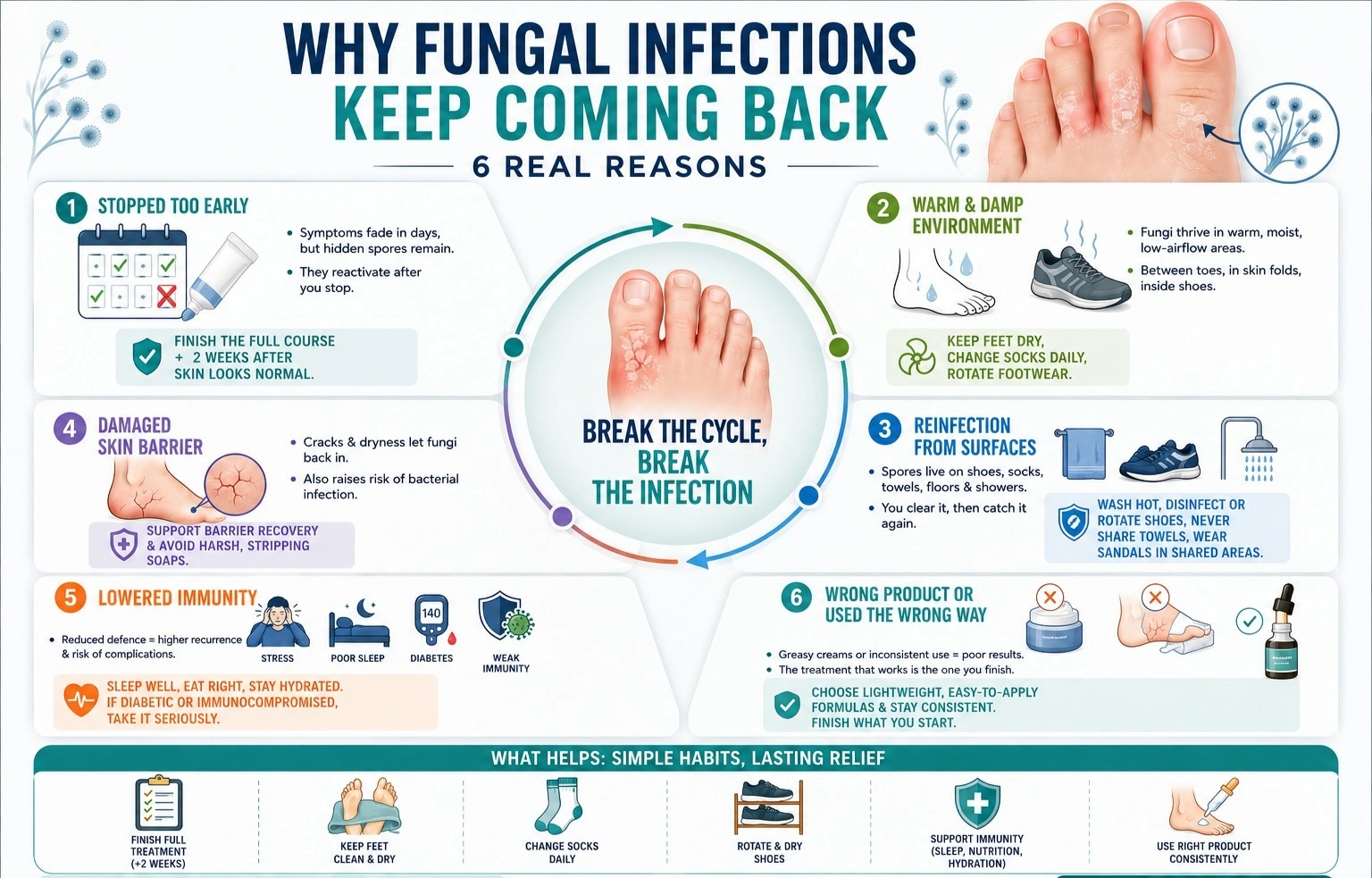
1. You stopped treatment too early. This is the single biggest driver. Surface symptoms — itch, redness, burning between the toes — ease within three to seven days because the active, growing fungus (hyphae) is suppressed first. But dermatophytes also produce dormant spores (arthrospores) sitting in the deeper, still-renewing layers of skin. Those are not under pressure once you stop, and they reactivate as fresh skin forms over them.
What helps: finish the full course, then keep treating for two more weeks after the skin looks completely normal.
2. The skin stays warm and damp. Dermatophytes thrive in warm, moist, low-airflow conditions — between the toes, in skin folds, inside shoes worn all day. Return those conditions and you hand any surviving spore exactly the environment it needs to wake up.
What helps: dry thoroughly between the toes, change socks daily, rotate footwear so shoes fully dry out.
3. Your shoes, socks and towels are reinfecting you. Spores survive on fabric and surfaces long after your skin has cleared. You can biologically clear the infection on your body and still get reinfected from your own footwear, gym floors and shared showers. Clearance of the skin without decontamination of the environment produces reinfection, not cure.
What helps: wash socks and towels hot, disinfect or rotate shoes, never share towels, and wear sandals in shared wet areas (an American Academy of Dermatology prevention recommendation).
4. The skin barrier is damaged. Cracks, fissures and over-dried skin give fungi an easy way back in, and also open the door to secondary bacterial infection at the same sites.
What helps: support barrier recovery with restorative care; avoid harsh, stripping soaps on already-compromised skin. You can also find more practical guidance on maintaining healthy feet and preventing recurring fungal infections on the Cureforte website.
5. Lowered immunity. Stress, poor sleep, illness, diabetes or compromised immune function all reduce your natural defence and raise both recurrence risk and the risk of complications. Untreated tinea pedis can, in vulnerable groups, progress to cellulitis (per StatPearls, National Library of Medicine).
What helps: sleep, nutrition and hydration matter more here than people assume; if you are diabetic or immunocompromised, treat foot fungus as a medical issue, not a cosmetic one.
6. The wrong product — or the right product used inconsistently
A treatment only works if it is applied consistently for the full course. Thick creams can be difficult to spread between the toes, may leave residue inside socks, and are often discontinued once symptoms improve. Missed applications and early discontinuation are among the most common reasons fungal infections return.
What helps: Choose an antifungal formulation that is easy to apply consistently, reaches the spaces between the toes where fungi commonly persist, absorbs quickly, and is comfortable enough for daily use throughout treatment and the maintenance phase.
Serum formulations are particularly suited to these areas because they spread easily into narrow skin folds, absorb rapidly without leaving a greasy residue, and support long-term adherence. Products such as Cureforte Anti-Fungal Foot Care Serum, which combines Tolnaftate 1% with skin-supporting ingredients including tea tree oil, eucalyptus, rosemary and jojoba oil, are designed to support both active treatment and ongoing prevention when used as directed.
Although anyone can develop a fungal infection, some people are much more likely to experience repeated recurrences because the fungus has more opportunities to survive or re-establish itself.
You may be at higher risk if you:
Being in a higher-risk group does not mean fungal infections are inevitable, but it does mean that prevention is just as important as treatment. For these individuals, completing the full treatment course, maintaining good foot hygiene, and continuing a preventive antifungal routine can significantly reduce the likelihood of recurrence.
Consult a healthcare professional if your fungal infection does not improve after two weeks of appropriate antifungal treatment, continues to spread, repeatedly returns despite completing treatment, or involves the toenails. Seek medical attention promptly if you develop increasing redness, swelling, warmth, pus, fever, or severe pain, or if you have diabetes, poor circulation, or a weakened immune system, as these conditions increase the risk of complications and may require prescription treatment.
Two things are quietly making recurrence worse. First, spore biology: spores have thick cell walls, very low metabolic activity and stored energy, so they are physiologically built to outlast treatment and reactivate when conditions improve (Faway et al., Experimental Dermatology, 2018). Second, resistance: in 2024 the CDC formally flagged terbinafine-resistant dermatophytes — including Trichophyton indotineae — as an active US public-health concern, with many infections no longer resolving on standard OTC or oral terbinafine. Every started-and-abandoned treatment cycle adds selection pressure for exactly these strains.
Plain version: stopping early does not just cost you a relapse — it is part of how the fungus, as a population, is learning to ignore our drugs.
The pharmacy-shelf model is single-phase — treat until symptoms clear, then stop. The biology needs three.
| Phase | Duration | Goal & what to use |
|---|---|---|
| 1. Active treatment | 2–4 weeks | Suppress active fungus and resolve symptoms. Use a pharmaceutical antifungal (terbinafine, clotrimazole or tolnaftate) twice daily. |
| 2. Post-clearance extension | 2 weeks after symptoms gone | Keep pressure on dormant spores while the skin-renewal cycle completes. Continue the same antifungal; decontaminate footwear and surfaces at the same time. |
| 3. Daily maintenance | Ongoing | Prevent recolonisation in high-exposure feet. Daily antifungal with barrier support — e.g. tolnaftate 1%, which is FDA-labelled for prevention of recurrence, alongside skin-restoring care. |
Tea tree oil (Melaleuca alternifolia) appears in many OTC antifungal products, and the claims around it run from well-supported to overstated. Honestly: its active compound, terpinen-4-ol, has confirmed antifungal activity against dermatophytes across multiple peer-reviewed studies, including a 2024 EUCAST-protocol study, and it works through a different mechanism (membrane disruption) than terbinafine — which matters as terbinafine-resistant strains spread.
But — and this is the line cheaper marketing crosses — in head-to-head lab comparisons pharmaceutical antifungals outperform tea tree oil at equivalent concentrations. Tea tree oil is not a first-line cure for an active infection. Its evidence-supported value is in maintenance and prevention (Phase 3): sustaining antifungal pressure and supporting the skin barrier once active treatment is done.
Fungal infections do not just need treatment — they need a finish line that is set by biology, not by how your skin feels on day five. Treat fully, keep going for two weeks past “looks normal,” decontaminate your environment, and maintain daily if your feet live in shoes and shared showers. Change the environment, protect the barrier, stay consistent — and the trip back to the pharmacy three months later usually doesn’t happen.

Reviewed and developed by the Cureforte Editorial Team with inputs from co-founder Bindiya Nair (Gupta), whose experience spans over 15 years in wellness, product innovation, and consumer health. Her work across therapeutic care, OTC formulations, beauty and wellness products, and international markets has shaped a practical, evidence-driven approach to developing balanced health solutions. More of her work at bindiyanair.com.