
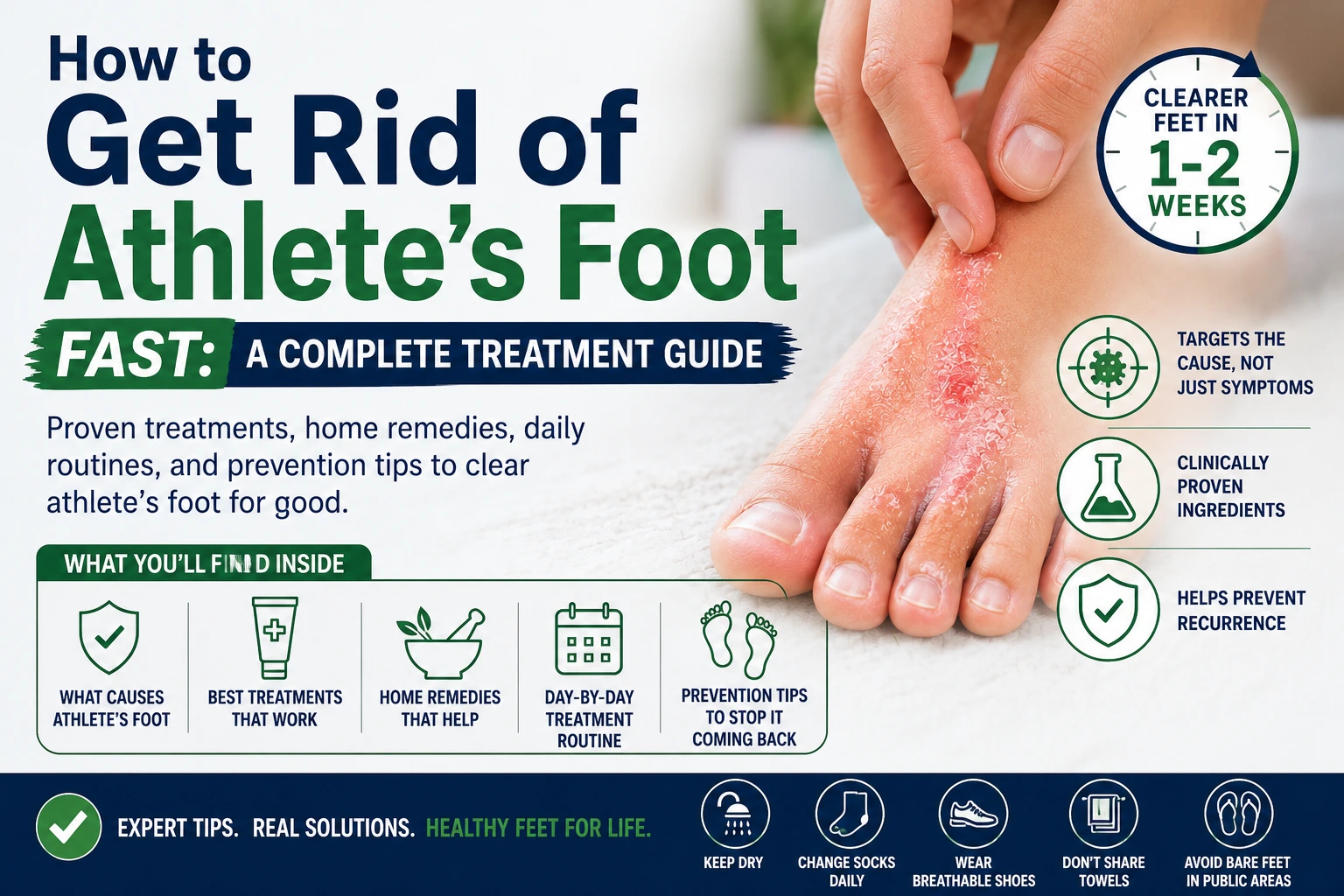

That constant itch between your toes is not something you just have to live with. Athlete’s foot is a fungal infection, and it will not clear up on its own for most people — but the right treatment, used properly, can fix it in a matter of weeks. This guide covers exactly what works, what does not, and how to stop it coming back once it clears.
You’re Not Dirty. You Just Have a Very Common Fungal Infection
Let’s get something out of the way. Athlete’s foot has nothing to do with poor hygiene, and it definitely is not something only athletes get. The Cleveland Clinic puts it plainly: it’s most common in men and people over 60. Not gym rats. Regular people who wear shoes.
The fungus behind it — a group called dermatophytes — feeds on the dead skin cells on the outer layer of your feet. It needs two things to survive: warmth and moisture. The inside of a shoe after a long day gives it both. So does the floor of a shared shower, a damp sock, or even a bathroom tile that someone with an active infection walked across.
Here is something worth knowing. According to clinical data, an athlete’s foot only clears on its own in about 30 to 40% of cases without any treatment. That means if you have it right now and you are hoping it will just go away — there is a better than 60% chance it will not. It will spread, get worse, or move to your toenails, where it becomes a whole different and much harder problem to fix.80
So let’s deal with it properly.
What Type Do You Actually Have?
Not all athlete’s foot looks the same. There are three types, and they behave differently enough that it is worth knowing which one you are dealing with before you grab a product off the shelf.
- The Tricky One: Dry, Scaly Soles
This type, called moccasin athlete’s foot, is surprisingly easy to mistake for just dry skin. The skin on the bottom and sides of your foot becomes thick, rough, and flaky. It rarely itches much. Many people with this type spend months moisturising their feet and wondering why nothing helps. It is a fungal infection, not dryness, and it needs an antifungal — not a cream. It is also the hardest type to treat and often needs a longer course or prescription medication. - The Painful One: Blisters
The third type appears as sudden fluid-filled blisters, usually on the sole or instep of the foot. This is vesicular athlete’s foot, and it can be genuinely painful. If those blisters break, the open skin becomes an entry point for bacteria — which is when things can escalate quickly. - Could It Be Something Else?
Quite possibly. Eczema on the feet, contact dermatitis from a shoe material, and even psoriasis can all look similar to athlete’s foot. The key difference is that none of those conditions respond to antifungal treatment. If you have been treating something with antifungal cream for two full weeks and nothing has changed at all, go and see a dermatologist before you continue. You might be treating the wrong thing entirely.
What Actually Works: A Straight Answer on OTC Treatments
There is a lot of noise about athlete’s foot treatments. Here is what the clinical evidence actually says.
- Terbinafine: Fastest, Most Studied
Terbinafine belongs to a class called allylamines. When applied correctly twice a day, it achieves around a 70% cure rate in one to two weeks — faster than most other OTC options. If a doctor prescribes it in tablet form (250mg), the clinical cure rate climbs to 94%, which is the highest recorded for any athlete’s foot treatment according to MDedge clinical review. For most mild to moderate cases, terbinafine cream or spray is the place to start. - Clotrimazole and Miconazole: Solid, Takes a Bit Longer
Both are azole antifungals. They take two to four weeks, but they work reliably across all three types of athlete’s foot. Miconazole also has mild antibacterial properties, which is worth knowing if the infected skin shows any signs of secondary infection — redness, warmth, or swelling beyond the expected fungal area. - Tolnaftate 1%: Established, Good for Recurrence Prevention
Tolnaftate has been used in OTC antifungal treatment for decades. It works differently from the azoles — it blocks a specific enzyme the fungus needs to build its cell wall while also disrupting the thread-like structures the fungus uses to spread across the skin (MedicineNet). According to MedlinePlus, burning and soreness typically start to ease within two to three days. A proper course runs four to six weeks.
What makes Tolnaftate particularly worth considering is its prevention benefit. The FDA drug label states clearly that with continued daily use, it helps stop the infection from returning. For people who keep getting athlete’s foot back — and there are a lot of them — that dual action (treat and prevent) matters.The format of what you use matters too. Thick creams stay on the surface. Powders help with moisture but do not absorb deeply. Serums absorb quickly into the skin, which means the active ingredient actually reaches where it needs to go — especially important for the tight spaces between toes.
The One Habit That Causes Most Recurrences
Stopping treatment too early. Your skin looks normal, the itch has gone, you stop using the product. Three weeks later, it’s back.
Here is why. The skin surface renews itself every two to six weeks. Fungal spores live in the deeper layers of skin even when the surface looks clear. Stop treating early, and those spores regrow once the antifungal is gone. The rule is simple: keep treating for one to two full weeks after all visible symptoms have disappeared. Not when it feels better. When it is gone — and then some.
- Terbinafine: Fastest, Most Studied
Home Remedies: What Genuinely Helps and What Wastes Your Time
Home remedies are not a replacement for antifungal medication. That needs to be said clearly. But some have real evidence behind them as supporting treatments that can ease symptoms and speed things up when used alongside the right product.
- Tea Tree Oil
This is the most studied natural option for athlete’s foot, and the evidence is genuinely decent — though not as strong as for pharmaceutical antifungals.
A randomised, double-blind trial by Carson et al. (1996) found that 50% tea tree oil solution applied twice daily led to 64% clinical cure, compared to 31% in a placebo group. A 2002 study by Satchell et al. confirmed similar results. WebMD reports that around 70% of people using tea tree oil gel twice daily for a month saw measurable improvement, versus 40% with placebo.
Mayo Clinic’s honest assessment: a tea tree oil cream applied for a month may relieve symptoms, but it does not work as well as pharmaceutical antifungals
How to use it: dilute with a carrier oil like jojoba to around 25% concentration. Never apply undiluted tea tree oil to cracked or blistered skin — it will cause more irritation on already-damaged skin. - Apple Cider Vinegar Soaks
Mix one part apple cider vinegar with two parts warm water. Soak for 15 to 20 minutes daily. The acetic acid creates a mildly acidic environment on the skin that the fungus does not like. No large clinical trials prove a full fungal cure, but plenty of people find real relief from itching and inflammation this way. Use it as a symptom reliever, not a primary treatment. - Antifungal Foot Powder
Dusting antifungal powder between your toes and inside your shoes removes the moisture the fungus needs to survive. An antifungal powder (one containing miconazole or tolnaftate) works better than plain talcum for active infections. This is also one of the best ongoing habits once the infection clears. - What to Skip
Bleach soaks will burn already damaged skin. Do not try them. Rubbing alcohol dries the skin out and makes cracking worse. Garlic shows antifungal activity in lab tests but there are no solid clinical studies showing it works on human skin infections. Save the garlic for cooking.
The Daily Routine That Gets Real Results
There is no magic product. The difference between people who clear athlete’s foot and people who keep getting it back usually comes down to one thing: whether they follow a consistent daily routine.
How Long You Should Realistically Expect This to Take
- Mild cases caught early: one to two weeks.
- Moderate infections that have spread across the foot: two to four weeks.
- Moccasin-type or blistering cases: four to six weeks, sometimes longer.
- Nail involvement: three to six months minimum, usually with oral prescription medication.
Now that you know the timeline, here is what your daily routine should look like to hit those targets.

Morning
Wash both feet with soap and warm water. Get between every toe — including the ones that do not itch. Pat dry gently with a clean towel that you use only for your feet. Apply your antifungal treatment in a thin layer across the affected skin and roughly a centimetre past the visible edge of the infection. Wait for it to dry before putting on socks. Wear cotton or moisture-wicking socks and shoes that let your feet breathe.

Evening
Take your shoes off when you get home. Let your feet air out for a while. Wash them again, dry carefully, re-apply the antifungal. If you can, sleep without socks. Fungus does not thrive in dry, airy conditions — bare feet overnight makes a difference.

Weekly
Wash all socks at 60 degrees Celsius or hotter. This temperature kills fungal spores in the fabric. Spray the inside of your shoes with an antifungal spray or dust them with antifungal powder. Never wear the same pair of shoes two days running — give each pair at least 24 hours to dry out completely.
Why Cureforte Is Different
Cureforte Anti-Fungal Foot Care Serum combines:-
- Tolnaftate 1%
- Tea tree oil
- Eucalyptus oil
- Rosemary oil
- Jojoba oil
Unlike thick creams, serum delivery absorbs rapidly between toes and may support adherence because application takes under 30 seconds.

How to Tell Your Feet Are Getting Better
Burning and itching should ease noticeably within two to three days of starting the right antifungal. By week two, the skin should look less angry — less red, less peeling, no new blisters. This is exactly the moment when most people stop. Do not stop. Continue for at least one to two more weeks.
When a Pharmacist Is Not Enough
If there is no real change after 14 days of twice-daily treatment — not just some improvement, but no meaningful change — see a dermatologist or podiatrist. A specialist can confirm whether you actually have athlete’s foot or something else that looks like it. A simple test called KOH microscopy can give a definitive answer in the consultation room.
Go to a doctor straight away — do not wait two weeks — if you see rapidly spreading redness and swelling, have a fever, notice red streaks running up your leg from the foot, or see pus coming from broken blisters. These are signs of a bacterial infection that needs antibiotics. It is a medical problem, not just a fungal one.
Anyone with diabetes should see a doctor at the first sign of any foot skin problem, not after a fortnight of self-treatment.
What a Doctor Might Prescribe
Prescription topical antifungals — ciclopirox, econazole — go deeper and are stronger than what you find OTC. They are used when standard treatments have failed after two weeks of correct use.
Oral antifungal tablets are considered when the infection is severe, has spread to the nails, or has not responded to anything topical. Oral terbinafine at 250mg for two weeks has a 94% clinical cure rate — the highest of any treatment option for athlete’s foot (MDedge). Itraconazole is used for the moccasin type, with cure rates of 51% to 85%. Both carry potential side effects — headaches, stomach upset, liver strain with longer courses — which is why doctors try topical options first.
Stopping It From Coming Back
Most recurring athlete’s foot is not a failure of treatment. It is re-exposure from the person’s own environment — shoes, socks, and bathroom floors still carrying the fungus after the skin has cleared. The infection was treated. The source was not.
- Daily Foot Hygiene
Wash and dry your feet every day, including between each toe. Trim toenails short and straight — longer nails give fungi somewhere to settle. Never share towels, socks, or shoes with anyone, even family members. - Rethink Your Shoes
Breathable materials — leather, canvas, mesh — keep feet drier than rubber or plastic. Rotate your footwear and give each pair a full day to dry between wears. Apply antifungal powder inside shoes regularly. If you have had a long-running or recurring infection, replacing your most-used pair of shoes is worth considering. The fungus can survive inside shoe material and reinfect clean skin. - Public Spaces
The American Academy of Dermatology is clear on this: wear flip-flops or shower sandals in gym changing rooms, public pools, hotel bathrooms, and any shared shower. The fungus lives on damp floors and is picked up directly through bare skin. Five seconds to put on sandals is a real prevention measure. - Keep Using an Antifungal Daily, Even After It Clears
This is the step most people skip. Once the visible infection is gone, daily use of an antifungal product creates a protective layer that stops re-exposure from turning into a new infection.
This is where Cureforte’s Anti-Fungal Foot Care Serum fits naturally into a longer-term routine. The Tolnaftate 1% keeps fungal activity at bay. The jojoba and rosemary oils maintain the skin barrier. Eucalyptus keeps things feeling fresh. A quick daily application in the morning is all it takes — and it removes the need to restart a full treatment course every few months when the infection inevitably comes back through a shared shower floor or a damp gym shoe.
Athlete’s foot is common. It is treatable. And it is preventable, once you understand what actually causes it to keep coming back.
The approach that works is not complicated: use the right antifungal product twice daily, keep treating past the point where it looks clear, and deal with the environment — shoes, socks, surfaces — that would otherwise reinfect clean skin within days.
If you want one product that handles both the treatment and the daily prevention step, Cureforte’s Anti-Fungal Foot Care Serum with Tolnaftate 1% was made for that. Proven active ingredient. Fast-absorbing formula. Natural oils that repair what the fungus has been damaging. Twice-daily use fits into a normal morning and evening routine without any effort. At $29 for a 30ml serum, it is a practical starting point.
Start the routine today. By day three you will already feel the difference.
Quick Answers to the Questions People Actually Ask
Tea tree oil, eucalyptus, rosemary, and oregano all have documented antifungal properties supported by clinical research. Tea tree oil alone shows about 64% effectiveness in clinical trials. However, these oils work best as supporting treatments alongside a proven antifungal ingredient like tolnaftate. Cureforte’s serum combines these essential oils with Tolnaftate 1% — the antifungal treats the infection while the oils repair the skin barrier.
In about 30 to 40% of cases, yes. For everyone else — the majority — it does not clear without treatment. It gets worse, spreads to the nails, or leads to something more serious.
Yes. More easily than most people realise. Shared towels, wet floors, and shared footwear are all routes. It can spread within a household without any direct person-to-person contact.
The itch and burning ease first — within two to three days of correct treatment. Skin texture and colour normalise over the following one to two weeks. No new peeling or blisters forming is a reliable sign things are moving in the right direction.
No, where possible. Air circulation overnight works against fungal survival. If you must wear socks, use clean cotton ones.
Same organism, different tissue. Nail fungus develops when the infection spreads from skin into the nail. Nails are much denser than skin, so topical creams rarely penetrate deeply enough. Oral medication is usually needed, and treatment runs three to six months.
Tolnaftate 1% is an FDA-approved antifungal ingredient with decades of clinical use. It starts easing symptoms within 2 to 3 days and, with continued daily use, helps stop the infection from returning. It is effective against the athlete’s foot and ringworm.
Tea tree oil, eucalyptus, rosemary, and oregano all have documented antifungal properties. Cureforte’s Anti-Fungal Foot Care Serum combines these oils with Tolnaftate 1% — the essential oils support the skin barrier while the antifungal ingredient treats the infection directly. Tea tree oil alone shows about 64% effectiveness in clinical trials, but works best as a supporting treatment alongside a proven antifungal.
Author
-
Reviewed and developed by the Cureforte Editorial Team with inputs from co-founder Bindiya, whose experience spans over 15 years in wellness, product innovation, and consumer health. Her work across therapeutic care, OTC formulations, beauty and wellness products, and international consumer markets has shaped a practical, evidence-driven approach to developing balanced health solutions.
